

Fall planting of tall fescue pastures; Manage musk thistle now; and Spurge identification and control in forages
Fall planting of tall fescue pastures
Tall fescue is best seeded in the fall in Kansas pastures and hay meadows, especially when rainfall has been abundant. By starting now with soil tests, variety selection, and seedbed preparation, tall fescue can be a productive pasture for many years to come.
Both tall fescue and smooth bromegrass make good cool-season permanent pasture in eastern Kansas (Figure 1). Tall fescue is hardier, more grazing-tolerant than smooth bromegrass, and more tolerant of wet conditions. Tall fescue can be utilized for fall and winter grazing much better than smooth bromegrass.
Be sure to use either endophyte-free or nontoxic (sometimes called novel or “friendly” endophyte-infected) varieties of tall fescue when establishing a new pasture, or renovating an old pasture if improved animal performance is the main objective. Endophyte-free fescue often lacks its competitive nature in droughty and overgrazing situations, as the endophyte fungus is fully gone. This can also lead to endophyte-free varieties becoming infected if Old KY-31 or similar endophyte varieties still exist in a stand, as the pathway can be filled in. Think of it as a puzzle missing a piece. Novel or “friendly” endophyte fescues have more vigor and drought tolerance, limited livestock toxicity, and have a puzzle piece in that gap to mitigate infection. Old KY-31 endophyte-infected fescue would be acceptable to plant where you know excessive grazing will occur, for example, in grass traps or pens for animal receiving facilities. In these examples, the main goals are ground cover and animal comfort.
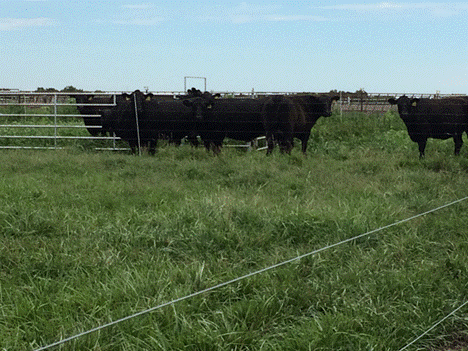
Figure 1. Tall fescue pasture near Parsons. Photo by Doohong Min, K-State Research and Extension.
Site selection
Tall fescue will grow on almost any soil but produces best on fertile, moist soils. The ability of tall fescue to withstand low fertility and wet soil is excellent. Tall fescue can also withstand submersion for a few days. It will produce on soils with a pH of 5.2 to 8.0, but optimum growth occurs in the 5.8 to 7.0 pH range.
Varieties
Several new varieties are suitable for Kansas. New, certified varieties are either free of the endophyte fungus or contain the “friendly” nontoxic endophyte that does not produce the ergovaline toxin detrimental to livestock. Endophyte-free seed of older varieties like Kentucky-31 is also available. Check the seed tag to be sure of the endophyte level and type. To avoid reduced animal performance resulting from toxic endophyte-infected grass that is fed or grazed, livestock producers should plant the seed free of live toxic endophyte. Plants produced from fungus-free seed remain free of the endophyte. But as previously stated, productivity can be lower in varieties without the endophyte.
The Southeast Agricultural Research Center has tested tall fescue varieties. The table below is from “Evaluation of Tall Fescue Cultivars,” in the SEARC’s 2017 Agricultural Research report: http://newprairiepress.org/cgi/viewcontent.cgi?article=1376&context=kaesrr
More recently, in 2021, five fescue varieties were established in a comparison trial at the Southeast Research and Extension Center, Columbus location. Data from the 2023 season show the performance of the three types of fescues and the importance of proper N fertility programs (Figures 2a &2b). The yield drag of endophyte-free, novel, and traditional showed up more in the second cutting compared to the first. This can be year-dependent, especially when drought conditions occur. To read more about this trial, please go to https://newprairiepress.org/kaesrr/vol10/iss2/10/.
Overall, the addition of nitrogen increased biomass production in all varieties evaluated. Bar Optima had the greatest response to the additional nitrogen in regard to biomass production, though 50 units of N produced the lowest total yield. When biomass was measured in May, Cajun at both 50 and 100 units of nitrogen had the greatest yield, followed closely by yields with 100 units of nitrogen on Bar Optima and Estancia. Atlas and K-31 fescue varieties at both 50 and 100 units of nitrogen had similar biomass and had the lowest yields of the fertilized treatments.
Figure 2a-b. Forage accumulation of five fescue varieties with two cutting dates: a) May and b) September in 2023 at three nitrogen rates (0, 50, and 100 lbs N/ac). Atlas is endophyte-free, BO_E34 (Bar Optima) is novel endophyte, Cajun is endophyte-free, Estancia is novel endophyte, and K31 is the old standard carrying endophyte and often produces ergot alkaloids.
Seedbed preparation
Tall fescue establishes best in a well-limed and fertilized seedbed that has been tilled 4 to 6 inches deep, leveled, and firmed before seeding. Several producers report successful stands by simply broadcasting or no-tilling the seed into existing overgrazed grass pastures in the fall. Even though the practice works on occasion, it is not recommended. A well-prepared seedbed improves chances of rapid stand establishment.
A soil test should be taken well ahead of planting to determine lime and fertilizer needs, and needed lime and phosphate should be incorporated into the seedbed before planting. About 30 – 40 pounds of N per acre should be applied at or before planting.
An existing tall fescue stand will tolerate pH as low as 5.0. On existing pastures with a pH less than 6.0, 2 tons of agricultural lime per acre, topdressed, will increase the life of the stand and the growth of legumes if present.
Stand establishment
The proper planting dates for each area in Kansas are shown in Figure 3. On droughty, claypan soils, only fall plantings are recommended because winter and spring plantings may not survive if summers become hot and dry. However, if a moist summer persists, seedlings may establish well. Deeper soils and/or good moisture supplies will result in successful winter or spring seedings. When planting in a well-prepared seedbed, 12 – 20 pounds per acre of pure live, high-germinating seed is adequate. When seed germination is not known or the seedbed is less than desirable, a rate of 20 to 25 pounds per acre may be required for a satisfactory stand. For drilled seedings, use the lower end of that seeding rate range. For broadcast incorporation, use the higher end of the range. On average, tall fescue germinates in temperatures as low as 40°F.
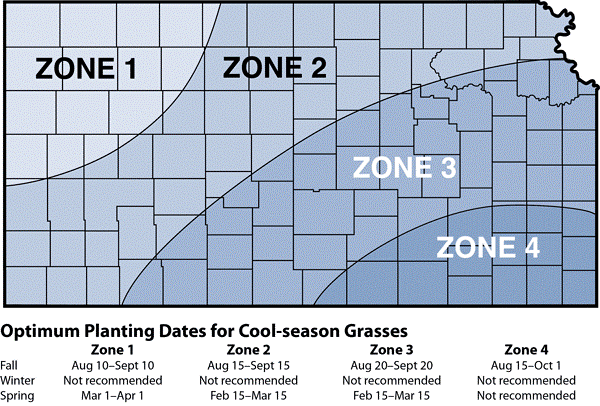
Figure 3. Recommended planting dates for tall fescue for each area in Kansas. Map from K-State Research and Extension.
For best results, seed should be covered with 1 ⁄4 to 3 ⁄8 inch of soil. Seeding tall fescue with winter wheat or an annual ryegrass assists with soil cover and weed suppression.. The wheat seeding rate should not be much higher than 60 lb/acre. Planting a cover crop like wheat can protect the soil from erosion and furnish additional grazing or grain production income in the seeding year. If wheat is grazed, avoid grazing in fall or spring when new grass seedlings could be injured by trampling during wet weather.
Converting endophyte-infected pastures
Establishing a new tall fescue pasture on ground with an existing endophyte-infected pasture requires some special care. The endophyte fungus that infects many tall fescue pastures in Kansas will survive in the seed up to 14 months. For that reason, you should prevent seed production on established endophyte pasture for 14 months before renovating with fresh seed. Otherwise, infected seed from the previous tall fescue may emerge along with the newly planted seed.
You can kill existing endophyte-infected tall fescue by applying glyphosate at the rate of 0.75 to 1.5 lb ae/acre when new growth is about 4 inches tall. It is easier to control fescue in the fall than in the spring; however, excellent spring control can be achieved. After tall fescue has been killed, producers could grow an alternative crop for one year that will allow the use of herbicides to control any volunteer tall fescue that emerges.
After 14 months without seed production from the old tall fescue, replant the field with an endophyte-free variety or a nontoxic endophyte variety. There are several nontoxic endophyte varieties on the market, including MaxQ, DuraMax Gold, and BarOptima Plus E34, but new nontoxic endophytes are continually being developed, so be watchful for their release.
More information
For more information, see Tall Fescue Production and Utilization, K-State Research and Extension publication C729, at: http://www.ksre.ksu.edu/bookstore/pubs/c729.pdf.
Doohong Min, Forage Management, dmin@ksu.edu & Tina Sullivan, Northeast Area Agronomist, tsullivan@ksu.edu
Don’t wait until summer: Manage musk thistle now
Musk thistle (Carduus nutans) is one of 12 noxious weeds in Kansas, infesting over 400,000 acres. It has been reported in nearly every county in Kansas (Figure 1) and is found primarily in pastures, rangeland, hay meadows, alfalfa, fallow, roadsides, and waste areas. Under the Noxious Weed Law, introduced in March 2021, musk thistle is considered a Category C weed. That means it is well established within the state and has an extensive population.
Control efforts should be aimed at reducing or eliminating new populations, and established stands should be managed with any accepted control method. Accepted control methods include mechanical, chemical, and biological approaches.
Mechanical control involves removing the entire plant or just the reproductive parts to prevent the plants from producing flowers/seeds. Mowing, digging, and hoeing are common mechanical methods of controlling musk thistle.
Several herbicides are labeled for musk thistle control and are discussed further below.
Biological control requires a permit and needs to be integrated with other methods. Head and rosette weevils are found in the state but cannot be transported across state lines. These biological controls tend to be slow-acting due to population establishment and may only favor areas with high moisture and high thistle density. A flower fly (Cheilosia corydon) is available as a biological control of musk thistle, though it has had limited movement in many musk thistle areas due to being a non-native species.
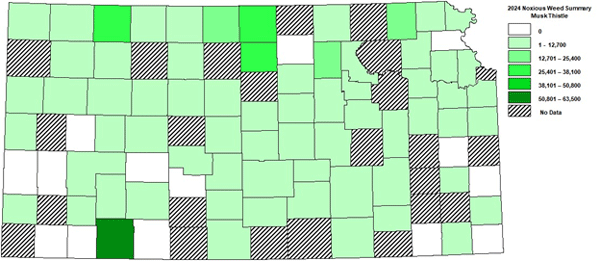
Figure 1. Distribution of musk thistle in Kansas. Map courtesy of the Kansas Department of Agriculture.
Musk thistle is primarily a biennial or winter annual species. Biennials take two growing seasons to complete their life cycle. Thistles germinating in the spring will spend the entire summer as a rosette, live through the winter, and bolt the next year in May and June. Winter annual plants will germinate with moisture and warm temperatures in the fall, live through the winter, and bolt the following year. This weed can act as a biennial, winter annual, and occasionally a summer annual, making control complex but manageable when multiple modes of action are implemented. Most people recognize musk thistle during the early summer when the plants are actively blooming (Figure 2, top photo). However, musk thistle control is easiest as a rosette (Figure 2, bottom photo).
Figure 2. Musk thistle in flowering stage (top photos with inset) and rosette stage after emerging in the fall and overwintering (bottom photo). Photos courtesy of Mike Haddock (top photos with inset) and Sarah Lancaster, K-State Research and Extension.
Chemical control. Fall is an excellent time to spray musk thistle as all are in the rosette growth stage. Another advantage of fall treatment is reduced risk of off-target drift. Waiting until most deciduous trees have lost their leaves and most crops are harvested will greatly reduce the likelihood of damage from herbicide drift. A wider window of opportunity for treating musk thistle also exists in the fall. The spraying window in the fall probably extends until the ground is frozen, and the musk thistle plants have shut down activity until warmer temperatures in the spring. Freezing temperatures will start to damage musk thistle plants, with some yellowing and curling of leaves. However, the plants are susceptible to herbicides as long as green tissue exists.
Dry conditions in the fall can reduce the control of musk thistle with certain herbicides. Still, studies in Kansas indicated that a fall application of 2,4-D LVE at 2 lbs per acre was more effective (80% control) than a similar rate of 2,4-D amine (49% control). Dicamba + 2,4-D amine at 0.25 + 0.75 lbs per acre and picloram at 0.125 lbs per acre were also effective (>90% control) on musk thistle treated in the fall. Other herbicides that have proven effective include 3-5 fl oz/acre aminopyralid (Milestone) and aminopyralid + metsulfuron (Chaparral at 1.5 oz/acre). Products containing picloram and aminopyralid will not only control rosettes treated in the fall but will have enough carryover to control emerging seedlings the following spring.
If you need to treat musk thistle this fall, select the proper herbicide for the job. If possible, select a warm, sunny day to spray. Scattered rosettes can also be mechanically removed by digging two inches below the crown.
Tina Sullivan, Northeast Area Agronomist, tsullivan@ksu.edu; Sarah Lancaster, Weed Science Extension Specialist, slancaster@ksu.edu; & Molly Reichenborn, Range Management Extension Specialist, mreichenborn@ksu.edu
Spurge identification and control in forage systems
In the past few weeks, questions have come in about managing spurge species in pastures and hayfields, especially where stands were thinned by fall armyworm damage. Spurges don’t compete well with healthy forage, so they usually aren’t a problem, and chemical control isn’t often needed. However, the sap is an irritant and can be toxic if ingested by animals. Thus, dense and/or large areas of infestation should be controlled. In Kansas, the three species most commonly seen are spotted spurge, prostrate spurge, and nodding spurge, with nodding spurge being the one most likely to show up in pastures and hayfields (Figures 1 and 2). The other two are more often found in lawns, gardens, or along sidewalks. This article will supplement information shared last week about general weed control and annual brome control in damaged cool-season grass pastures and hayfields.
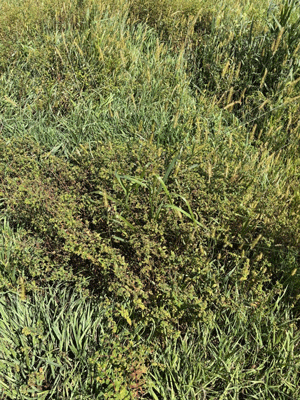
Figure 1. Nodding spurge growing in a cool-season forage stand damaged by fall armyworms. Photo credit to Rod Schaub of Frontier District.
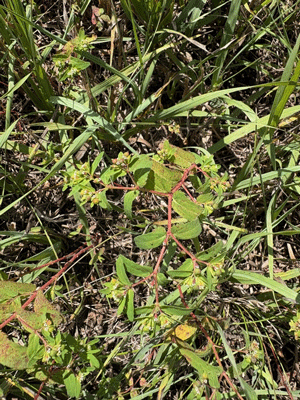
Figure 2. Close-up of nodding spurge growing in thinning, cool-season grass. Notice the more upright growth pattern. Photo credit to Rod Schaub of Frontier District.
Identification
All three plants are summer annuals that can germinate and emerge in a wide range of environments. Table 1 lists identifying characteristics of the three plants. Like others in the spurge family, such as toothed spurge and snow on the mountain, all three species exude milky sap when the stems are broken. Spotted and prostrate spurge are very similar and even considered to be one species by some scientists. Inconspicuous flowers are found at the base of leaves throughout the summer, and all three species are prolific seed producers. In suitable conditions (warm and wet), seeds that fall from the plant will germinate; in unsuitable conditions, seeds will remain dormant until next spring. Much like other weeds, it is important to control the seed bank and promote forage production with a good fertility program.
Table 1. Characteristics of spotted, prostrate, and nodding spurge.
| Spotted spurge | Prostrate spurge | Nodding spurge | |
| Distribution | Throughout Kansas | Eastern Kansas | Throughout Kansas |
| Stems | Prostrate, pink, hairy, up to 20 inches long, does not root at nodes | Prostrate, pink, hairy, up to 20 inches long, roots at nodes | Green and red, up to 30 inches tall, hairs on upper nodes |
| Leaves | Opposite, egg-shaped to elliptic, with a red spot at the base, hairy, serrated margins, 1/8 to 2/3 in long | Opposite, egg-shaped, red spot at the base, hairy, margins may be serrated, 1/8 to 2/3 in long | Opposite, oblong, few hairs, margins irregularly toothed, 1 to 12/3 inches long |
| Flowers | Inconspicuous, at base of leaves in the upper stem, appear clustered | Inconspicuous, at base of leaves in the upper stem, single or in pairs | Inconspicuous, at base of leaves in the upper stem |
| Fruit/seeds | 3 seeds contained in a three-lobed capsule | 3 seeds contained in a three-lobed capsule | 3 seeds contained in a three-lobed capsule |
Management
During establishment, infestations can be reduced in fall seedings compared to spring, due to an environment that is not conducive to germination of the weed seeds. Mowing will not be effective, as these plants are adapted to low-growing environments.
Products that contain pendimethalin (Prowl H2O, others) can suppress the emergence of spurge species when applied before germination. Postemergence options include herbicide triclopyr (Remedy Ultra, others) and fluroxypyr (Vista, others), and imazapic (Plateau, others).
Sarah Lancaster, Extension Weed Science Specialist, slancaster@ksu.edu & Tina Sullivan, Northeast Area Agronomist, tsullivan@ksu.edu
 Kansas Forage and Grassland Council
You must be logged in to post a comment.