

Herbicides for cool-season hayfields and pastures damaged by fall armyworms
There were a large number of fall armyworm infestations in July and August in hayfields and pastures throughout parts of eastern Kansas. In most fields harvested in mid-to-late July, cool-season smooth brome and tall fescue are starting to regrow slowly due to hotter temperatures. Some of these fields were sprayed with insecticide already, but there is potential for a second generation of fall armyworms to cause additional damage while the grasses use their reserves for regrowth. As a result, some damaged fields may need to be replanted. Fields with localized patches of damaged forage are likely to have weed encroachment, likely from late summer and winter annuals (Figure 1).
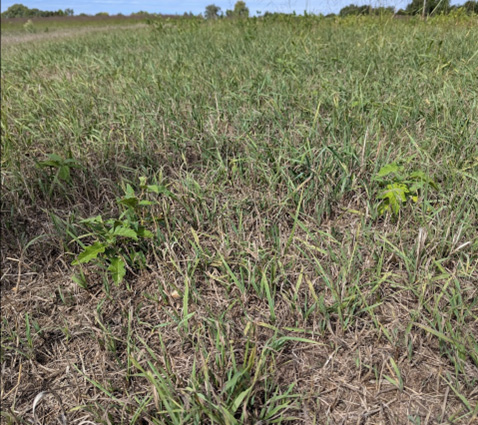
Figure 1. Broadleaf weed horsenettle encroaching into a fall armyworm-damaged smooth brome hayfield in Jackson County. Photo by Tina Sullivan, K-State Research and Extension.
For the dead fields, growers could reseed or overseed in the fall or spring, but weeds should be controlled to limit competition and additional weed seed in the seed bank. Controlling emerged weeds will be critical for successfully establishing a new stand. Light tillage or a non-selective herbicide can be used to control any emerged winter annual weeds prior to seeding. Herbicide options are limited during establishment (Table 1). Mowing is a non-chemical option that could be considered to reduce weed competition and prevent weed seed production during grass establishment. If a herbicide application is needed prior to seeding, be sure to observe plant-back intervals that may interfere with establishment.
On the other hand, in some of the damaged fields, growers can wait to see if the desired grass will come back. In this case, more herbicide options are available; however, several will suppress forage growth (Table 1).
Table 1. Herbicides labeled for post-emergence weed control in cool-season forage grasses (SB=smooth brome; TF=tall fescue). Consult the label for the appropriate rate and adjuvant selection.
| Herbicide | Active ingredient | Desired grass species | Weeds controlled | Used in establishment | Plant-back interval | Smooth brome suppression |
| 2,4-D | 2,4-D | SB, TF | Broadleaf | After 6 leaf stage | 30 days | Unlikely |
| Amber | Triasulfuron | SB | Broadleaf | 60 days after emergence | 4 months | Unlikey |
| Chaparral | Metsulfuron + aminopyralid | SB, TF | Broadleaf | No | 1 year | Likely |
| Cimarron Plus | Metsulfuron + chlorsulfuron | SB, TF | Broadleaf | 6 months – SB24 months – TF | 2 months | Likely |
| Clarity, others | Dicamba | SB, TF | Broadleaf | No | 45 days per 16 fl oz/A | May be injured with > 16 fl oz/A |
| Crossbow | 2,4-D + triclopyr | SB, TF | Broadleaf | No | 3 weeks | Possible |
| DuraCor | Aminopyralid + florpyrauxifen | SB, TF | Broadleaf | No -SB3 leaves – TF | 45 days – SB15 days – TF | Likely |
| Escort, others | Metsulfuron | SB, TF | Broadleaf | 6 months – SB24 months – TF | 2 to 4 months – SB18 months – TF | Likely |
| Facet, others | Quinclorac | SB, TF | Grass/broadleaf | No | 10 months | Unlikely |
| Grazon P+D | Picloram + 2,4-D | SB, TF | Broadleaf | No | 60 days – SB21 days – TF | Likely |
| GrazonNext HL | Aminopyralid + 2,4-D | SB, TF | Broadleaf | No | Grasses may be reseeded in the fall following an application in spring or early summer | Likely |
| Huskie FX | Pyrasulfotole, bromoxynil, fluroxypyr | TF | Broadleaf | > 2 leaves | 1 month | Not labeled for use in SB |
| Milestone | aminopyralid | SB | Broadleaf | No | 1 year | Likely |
| PastureGard HL | Triclopyr + fluroxypyr | SB, TF | Broadleaf | After tillering | 3 weeks | Possible |
| Plateau, others | Imazapic | SB | Grass/broadleaf | No | 26-36 months | Likely |
| Range Star | 2,4-D + dicamba | SB, TF | Broadleaf | > 6 leaves | 3 weeks per quart | Possible |
| Rave | Triasulfuron + dicamba | SB | Broadleaf | 60 days after emergence | 4 months | Possible |
| Remedy Ultra, others | Triclopyr | SB, TF | Broadleaf | No | 3 weeks | Possible |
| Tordon 22K | Picloram | SB, TF | Broadleaf | After tillering | Grasses may be reseeded in the fall following an application in spring or early summer | Likely at rates > 1 qt/A |
| Yukon | Dicamba + halosulfuron | SB, TF | Broadleaf | No | 2 months | Possible |
The use of trade names is for clarity to readers and does not imply endorsement of a particular product, nor does exclusion imply non-approval. Always consult the herbicide label for the most current use requirements.
Sarah Lancaster, Weed Management Specialist, slancaster@ksu.edu
Tina Sullivan, Northeast Area Agronomist, tsullivan@ksu.edu
Annual weedy brome control in hayfields and pastures
Fall is a good time to control weedy annual brome species such as downy brome, Japanese brome, and cheat. These weeds are not a new problem, but an increasing number of producers are reporting an increase in these undesirable grasses emerging in thinning stands. In pastures or hayfields, young or immature annual bromes can make suitable forage, but when the plants mature, they become less palatable, as stiffened awns become a livestock hazard, and crude protein drops to less than 3%. This article will discuss some identifying characteristics for each, as well as control measures.
Identification
Three weedy brome species are prevalent in Kansas. All are winter annual species, and their seedling leaves all have a clockwise twist. Key identifying features are shown in Table 1.
- Cheatgrass (downy brome; Bromus tectorum) is covered with soft hairs on both leaf surfaces, and the closed sheath is also covered with soft hairs. Mature plants can reach up to 2 feet tall with leaves up to 5 inches long.
- Japanese brome (Bromus japonicus) seedlings are difficult to distinguish from cheatgrass, but mature plants typically grow taller than cheatgrass and have awns that are slightly bent.
- Cheat (Bromus secalinus) seedlings lack the hairy leaves and have shorter awns.
Given the challenge of distinguishing the three species, it is fortunate that most management recommendations will be similar for all three.
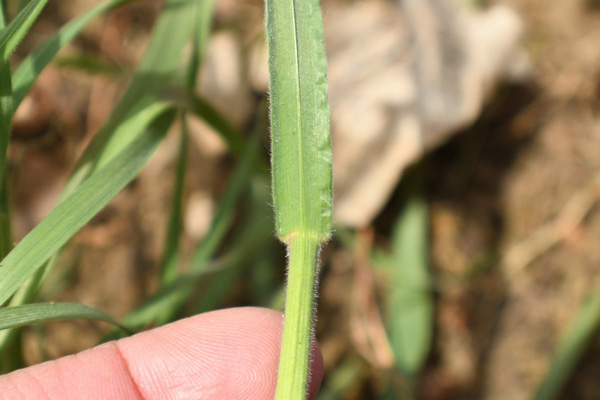
Figure 1. Cheatgrass (pictured) and Japanese brome have dense hairs on the upper and lower leaf surfaces as well as on the leaf sheath. Cheat has fewer hairs on the leaf, and the leaf sheath is usually hairless. Photo by Sarah Lancaster, K-State Research and Extension.
Table 1. Identifying features that distinguish among downy brome, Japanese brome, and cheat.
| Cheatgrass (Downy Brome) | Japanese Brome | Cheat | |
| Leaf surface | Soft, short hairs on both surfaces | Soft hairs on both surfaces | Occasional hairs |
| Sheath | Hairy | Hairy | Hairless to occasional hairs |
| Ligule | Fringed membrane | Fringed membrane, slightly pointed | Fringed membrane |
| Spikelet | Long awns (0.75 inches) | Awns slightly bent | Short awns (0.4 inches) |
Herbicide options
As with most weeds in perennial grass pastures or hayfields, the best management is a dense stand of the desirable forage. This means that soil fertility should be closely monitored, as well as grazing management and haying practices. In general, herbicides for weedy brome control should be applied sparingly, as they are likely to cause significant crop injury, especially in smooth bromegrass. It is also important to keep in mind that most of the products listed below are Group 2 (ALS-inhibiting) herbicides, and ALS-resistance has been confirmed in Japanese brome populations in Kansas. Weedy brome seeds remain viable approximately three years in the soil, suggesting that a few years of intensive herbicide applications, followed by forage management, can be successful.
Preemergence applications
One herbicide option is imazapic (Plateau, others; Group 2). It can be applied at 4 to 12 fl oz/A in established smooth bromegrass (not tall fescue). It must be applied in the fall before the annual brome germinates. Smooth bromegrass growth will be suppressed by applications of imazapic.
Aminopyralid (Milestone; Group 4) can be applied at 7 to 14 fl oz per acre prior to germination for suppression or control of weedy brome species. Other Group 4 herbicides, such as picloram (Tordon) and dicamba (several), may also suppress weedy brome species. Smooth bromegrass suppression is likely with these applications.
A preemergence herbicide option that is safe on smooth bromegrass or tall fescue is pendimethalin (Prowl H2O, others; Group 3). However, this product only provides weed suppression and requires about 1 inch of rainfall for activation. Pendimethalin should be applied before weeds emerge at 4 pts/A.
Postemergence applications
Propoxycarbazone (Lambient; Group 2) can be applied postemergence at 1.2 oz/A when weedy brome species are at the 2-leaf to 2-tiller growth stage. Smooth bromegrass suppression is likely to occur.
Experiments conducted in Montana suggest that picloram (Tordon 22K, others) applied at 26 fl oz/A before boot stage to Japanese brome or aminopyralid (Milestone) applied at 4 fl oz/A before heading to cheatgrass and Japanese brome will reduce seed production. Such applications may be useful for managing emerged broadleaf weeds or brush while preventing the addition of weeds to the seedbank.
Management challenges
One challenge that may arise when making herbicide applications to control weedy brome species in pastures or hayfields is the presence of a dense thatch layer. Mowing or burning prior to herbicide applications can help remove plant residue that may prevent herbicide deposition. Increasing spray volume and droplet size can also help penetrate a plant canopy or thatch layer. In addition, carefully-timed mowing can be used as a method to reduce weed seed production. Unfortunately, burning pastures in the absence of an herbicide application is likely to increase the density of weedy bromes, as burning removes barriers to germination and emergence.
Sarah Lancaster, Extension Weed Science Specialist, slancaster@ksu.edu
Tina Sullivan, Northeast Area Agronomist, tsullivan@ksu.edu
Meet the new K-State Range Management Extension Specialist
Molly Reichenborn joined the Department of Agronomy at Kansas State University in August as the new Range Management Extension Specialist based in Manhattan. Molly grew up near Wichita with her older brother and parents in Goddard, where she loved being outdoors and caring for animals. These interests led her to initially pursue a career at Sedgwick County Zoo, where she worked with both exotic species and heritage livestock breeds while pursuing her undergraduate degree in biology. It wasn’t until she took plant ecology and land management classes that rangelands came onto her radar. Once they did, she pivoted to a career focused on the grasslands that surrounded her, but she had never fully appreciated growing up.

Dr. Molly Reichenborn, Range Management Extension Specialist
Molly completed both her undergraduate and master’s degrees at Wichita State University. As a master’s student, she studied the recovery of a tallgrass prairie following herbicide management of Sericea (Lespedeza cuneata). She also worked with her master’s advisor, Dr. Greg Houseman, and the Tallgrass Legacy Alliance to test the utility of MapitFast and SprayLogger to track and treat Sericea populations on ranches in eastern Kansas. She then worked as project manager for a study led by Drs. Bill Jensen (Emporia State University), Greg Houseman (WSU), and Mary Liz Jameson (WSU) examining the response of plant, bird, and insect communities to cattle grazing on Conservation Reserve Program lands in Kansas. Molly recently moved back to Kansas for her new role after finishing her PhD at New Mexico State University, studying the impact and effective management of Honey mesquite (Neltuma glandulosa) shrub encroachment into arid rangelands.
Molly is excited to join the long history of excellent extension and research at K-State and work with stakeholders across the state to address current and emerging issues on rangelands. Her research focuses on improving land management practices for effective invasive species, woody plant encroachment, and grazing management. In her free time, Molly enjoys knitting, hiking, making sourdough, and long walks with her husband and pup. She can be reached via email at mreichenborn@ksu.edu.
 Kansas Forage and Grassland Council
You must be logged in to post a comment.