

Tips for fall planting
In 2024, approximately 585,000 acres of alfalfa were harvested in Kansas, which supports the dairy and livestock industry. Alfalfa hayfields help to supply forage that is highly digestible and high in protein due to being a leguminous crop. Late summer and early fall are often the best alfalfa planting windows for Kansas due to less weed pressure than spring planting, though there are some challenges.
Available moisture at planting is crucial for alfalfa establishment, but too much moisture can increase seedling disease incidence and reduce alfalfa nodulation and nitrogen fixation.
If soil moisture is available, northwest Kansas growers can plant as early as August 10. The optimum sowing date occurs later as we move towards southeast Kansas, where growers can plant until mid- to late-September. In other parts of Kansas, the optimal planting time is late August or early September, as we need to plant early enough to have three to five trifoliate leaves before the first frost (Figure 1).
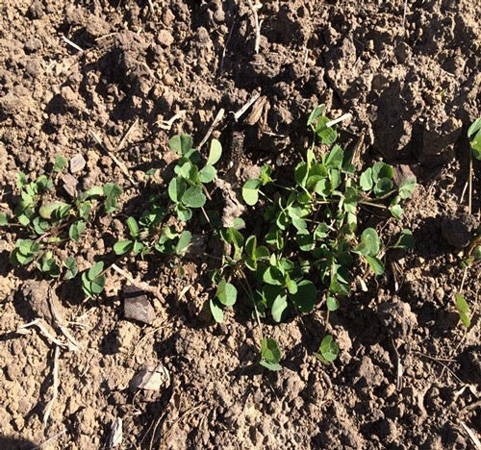
Figure 1. Alfalfa seedlings. Photo by Doohong Min, K-State Research and Extension.
Alfalfa is a four to five-year, or longer, investment, and therefore it is crucial to ensure proper establishment. Some producers shy away from alfalfa because of its high establishment cost and risk of stand failure. In the long run, however, it’s relatively inexpensive if recouped over the life of the crop.
Dryland alfalfa can produce 3 to 6 dry matter tons of forage per acre per year in well-managed conditions and favorable weather patterns. Irrigated fields can produce 6 to 8 dry matter tons per acre per year or more. Forage quality and tonnage depend on cutting frequency, percent bloom, and overall management of the crop (fertility, weeds, insects, etc.).
When sowing alfalfa, producers should keep the following in mind:
Soil test and correct soil acidity. Alfalfa grows best in well-drained soils with a pH of 6.5 to 7.5 and does not tolerate low soil pH. If the soil is acidic, add lime to raise soil pH to 6.8 before planting. Ensuring appropriate soil pH levels before planting is essential, especially as lime is relatively immobile in the soil profile and the field will not be worked for the next 3-5 years. Remember, after spreading, lime takes a few weeks or more in the soil to react and increase the pH.
Soil test and meet fertilization needs. Apply the needed phosphorus (P) and potassium (K) amounts according to soil test recommendations. Phosphorus fertilizer will be required if soil test P levels are below 25 ppm, and potassium fertilizer will be required if soil K levels are below 120 ppm. Depending on yield goals, soils that test higher than these thresholds may also need additional fertilizer. Small amounts of nitrogen fertilizer (15 to 20 lb/acre) as a starter at planting are beneficial for alfalfa establishment. In some fields, in particular those with sandier texture and low organic matter content, sulfur can also bring some yield benefits.
Plant certified, inoculated seed. Ensuring the correct Rhizobium inoculation is crucial for alfalfa seedlings to fix available soil nitrogen to meet the needs of growing alfalfa for optimum production. This inoculation is not the same as other legumes, such as soybeans and clovers.
Plant in firm, moist soil. A firm seedbed ensures good seed-soil contact; therefore, use a press wheel with the drill to firm the soil over the planted seed. No-till planting in small-grains stubble will usually provide a good seedbed.
Plant no deeper than 10 times the seed diameter. Don’t plant too deeply. Plant one-fourth to one-half inch deep on medium- and fine-textured soils and three-fourths inch deep on sandy soils.
Use the right seeding rate. Plant 8 to 12 pounds of seed per acre on dryland in western Kansas, 12 to 15 pounds per acre on irrigated medium- to fine-textured soils, 15 to 20 pounds per acre on irrigated sandy soils, and 12 to 15 pounds per acre on dryland in central and eastern Kansas.
Check for herbicide carryover that could damage the new alfalfa crop. This is especially true when planting alfalfa no-till into corn or grain sorghum stubble. In areas where row crops were drought-stressed and removed for silage, that sets up a great seedbed for alfalfa, but may still bring a risk of herbicide damage.
Choose pest-resistant varieties. Resistance to phytophthora root rot, bacterial wilt, fusarium wilt, verticillium wilt, anthracnose, the pea aphid, and the spotted alfalfa aphid is essential. Some varieties are resistant to even more diseases and insects, which could contribute to reducing costs.
Purchase alfalfa varieties with a fall dormancy rating ranging from 4 – 6 for Kansas. Fall dormancy relates to how soon an alfalfa variety will stop growing in the fall and how early it will begin growing in the spring or late winter. Simply put, it would be better not to buy a variety with fall dormancy of 9-10, which can be more suitable for California and regions where alfalfa can keep growing year-round under irrigation and warmer winter conditions.
More information about growing alfalfa in Kansas can be found in the Alfalfa Production Handbook. That information is also available on the web at: www.ksre.ksu.edu/bookstore/pubs/c683.pdf
Also see Alfalfa Growth and Development, available on the web at: https://www.bookstore.ksre.ksu.edu/pubs/MF3348.pdf
Deciding on the last cutting this fall
Alfalfa stops growing after the first hard freeze (when temperatures reach below 26°F), which in Kansas occurs on average around October 15. However, in some years, frost can occur as early as October 1 or as late as November 1. The decision should be weather-based at this time of the year because the timing of the last two cuttings impacts the winter survival and productivity of the stand in the following year.
Before fall dormancy, the last cutting should be made based on expected crown regrowth rather than one-tenth bloom because of the decreasing photoperiod. The last cutting should be made when there is 8 to 12 inches of foliage, or 4 to 6 weeks of growth time, before the first killing frost to allow adequate time for replenishment of root reserves. This means the second-to-final cutting should occur around early September. As the days get cooler and shorter, drying final cutting hay in a timely manner can become risky. Though tempting to bale before it’s properly dry, heat damage, mold, or spontaneous combustion fires occur commonly in fine-stemmed, high-quality, tightly packed bales. The additional factor of moisture makes the ideal environment for heat-producing microbes.
At this stage of the growing season, alfalfa plants need to store enough carbohydrates to survive the winter. If root reserves are not replenished adequately before the first killing freeze in the fall, the stand is more susceptible to winter damage than it would be normally. Winter damage can result in slower greenup and early growth next spring and, in some cases, stand loss due to winter kill. The potential of the alfalfa crop to grow new foliar tissue in the spring is greater with greater root reserves in the fall; thus, root reserves this fall are the main driver of the next crop’s yield and quality. Varieties are continually being selected for winter hardiness, but it is still important to manage varieties for the best success. Otherwise, spring growth can be reduced, and stand loss can occur.
The final cutting should occur right after the first killing freeze, before too many leaves have dropped. Producers should be prepared to enter the fields as soon as soil moisture conditions allow. After a killing freeze, the remaining forage (if any) can be hayed safely. However, the producer should act quickly because the leaves will soon drop off and lower the forage quality
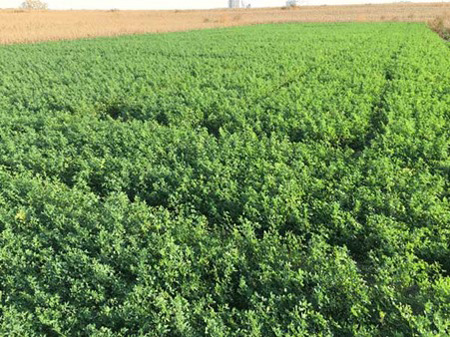
Figure 1. Alfalfa stand with approximately 12 inches of top growth prior to winter dormancy. The last cut in this stand was performed in early September, and this photo was taken in late October. This stand will be hayed immediately following the first killing frost. Photo by Romulo Lollato, K-State Research and Extension.
Consider soil sampling alfalfa fields now
Late fall is also a great time of the year to collect soil samples from alfalfa fields. This timing allows for an accurate assessment of available soil nutrients and provides enough time to make nutrient management decisions before the crop breaks dormancy in the spring. Key soil tests include pH, phosphorus, and potassium, and to a lesser extent, sulfur and boron. Potassium and winter survival are interrelated, resulting in having plant available potassium in an optimum range before winter is important. Kansas soils are commonly high in soil K values, but alfalfa is a K-demanding crop with each ton removing 60 lbs of K2O. When sampling for immobile nutrients, the sampling depth should be six inches, while mobile nutrients (sulfur) should be sampled to 24 inches. Based on the soil test, a fertility program can be established to ensure nutrient replenishment and maintain productivity. To submit soil samples to the K-State Research and Extension Soil Testing Laboratory, see this website: https://www.agronomy.k-state.edu/outreach-and-services/soil-testing-lab/.
Tina Sullivan, Northeast Area Agronomist
tsullivan@ksu.edu
John Holman, Cropping Systems Agronomist, Southwest Research-Extension Center
jholman@ksu.edu
Romulo Lollato, Wheat and Forages Specialist
lollato@ksu.edu
 Kansas Forage and Grassland Council
You must be logged in to post a comment.