

Plan ahead: Allow time for lime applications for alfalfa production
Correcting acidic soil conditions with lime application can significantly impact crop yields, especially for alfalfa. Acidic soils can significantly reduce nodule establishment and activity in alfalfa, affecting nitrogen status and overall nutrient and water uptake (Figure 1). Since seeding alfalfa is expensive and a stand is expected to last for several years, getting lime applied and acidity corrected before seeding is critical. Liming is one of the most essential but often overlooked management decisions a producer can make for alfalfa production as it tends to be more pH sensitive compared to other legumes like soybeans.
Unfortunately, lime is not always available in close proximity to where it may be needed. In many cases, trucking and spreading costs may be more than the cost of the lime itself. Lime quality can also vary widely, and no one wants to apply more than necessary. Knowing how lime recommendations are made can help make the best decisions on how much and what kind of lime to apply.
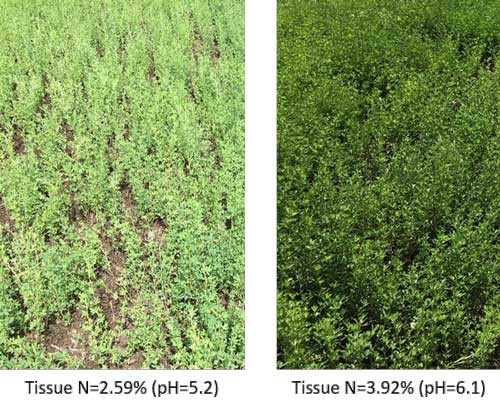
Figure 1. Soil pH affects nodule formation and activity for N fixation in alfalfa, in addition to nutrient availability and uptake. Photo by Dorivar Ruiz Diaz, K-State Research and Extension.
K-State lime recommendations
A routine soil test measures the soil’s pH, which determines whether lime is needed on the field. Generally, east of the Flint Hills, lime is recommended for alfalfa if the pH drops below 6.4, with a target pH for liming of 6.8. In the Flint Hills and west, lime is recommended for alfalfa and all other crops when the pH drops below 5.8, with a target pH of 6.0. The target pH is simply the pH goal once the lime reacts with the soil.
Why is the target pH different for the two areas of Kansas?
The target pH values differ because of the pH of the subsoil. East of the Flint Hills, especially south of the Kansas River, the subsoil tends to be more acidic. A higher target pH is used to ensure adequate pH conditions in the root zone and provide sufficient amounts of calcium and magnesium. Most soils from the Flint Hills and west have high pH (basic) subsoils that can provide calcium and magnesium to meet crop needs.
Determining the soil pH is the first step in determining if lime is needed. However, it does not tell you the amount of lime you need to apply. Soils with more clay and organic matter will have more acidity at a given pH and will require more lime/ECC (effective calcium carbonate) to reach a target soil pH than sandy soil. This is why two soils may have the same pH but different lime requirements.
Calculating lime rates
Lime rates are given in pounds of effective calcium carbonate (ECC) per acre. Lime materials can vary widely in their neutralizing power (ECC content). All lime materials sold in Kansas must guarantee their ECC content, and dealers are subject to inspection by the Kansas Department of Agriculture.
The ECC content of the lime depends on both its purity (relative to pure calcium carbonate) and its fineness. The finer the lime is ground, the greater the surface area of the product, the faster it will react, and the faster the acid neutralization will occur.
Lime sources
Research has clearly shown that a pound of ECC from agricultural lime, pelletized lime, water treatment plant sludge, fluid lime, or other sources neutralizes soil acidity equally. When selecting a lime source, the cost per pound of ECC should be a primary factor in source selection. Also consider the rate of reaction, uniformity of spreading, and availability, but the total ECC applied ultimately determines the final pH change.
Application methods
All lime sources have very limited solubility. When planting alfalfa, the best performance occurs when lime is incorporated and given time to neutralize the soil acidity (raise the pH). When surface-applied without incorporation, such as in no-till systems, the neutralizing effect is generally limited to the top 2 to 3 inches of soil. This may be adequate for slightly acidic soils, but it’s often not enough to fully correct problems in strongly acidic soils where root development, nodulation, and nitrogen fixation are more severely affected. Alfalfa roots go incredibly deep, thus interacting with more of the soil profile compared to most annual crops.
In no-till or reduced-till systems, where no incorporation of lime is planned, lower rates of lime application are normally recommended to avoid over-liming and raising the pH higher than needed in the surface 2-3 inches of soil. Over-liming can also reduce the availability of micronutrients such as zinc, iron, and manganese and trigger deficiencies in some soils. Current K-State lime recommendations suggest that “traditional” rates designed for incorporation and mixing with the top 6 inches of soil should be reduced by 50 percent when surface-applied in no-till systems or when applied to existing grass or alfalfa stands.
What about the calcium and magnesium contents?
Most agricultural limes found in Kansas contain both calcium and magnesium, with calcium exceeding magnesium. The exact ratio of these two essential plant nutrients will vary widely. Dolomitic lime (magnesium-containing) and calcitic lime (low-magnesium, high-calcium) provide similar benefits for most Kansas soils.
For more information, see the K-State publication Soil Test Interpretations and Fertilizer Recommendations, MF-2586: http://www.bookstore.ksre.ksu.edu/pubs/MF2586.pdf
Dorivar Ruiz Diaz, Soil Fertility Specialist, ruizdiaz@ksu.edu
Tina Sullivan, Northeast Area Agronomist, tsullivan@ksu.edu
Dual-purpose wheat variety performance results for 2025
An updated publication is now available in the Wheat Rx series that examines the performance of several wheat varieties grown for use in a dual-purpose system (grazing and grain). To be successful in dual-purpose systems, wheat varieties require traits sometimes overlooked in grain-only systems. These include fall forage yield, date of first hollow stem, grazing recovery potential, resistance to viral diseases transmitted when the crop is planted early, no high-temperature germination sensitivity, long coleoptile, and greater tolerance to low soil pH and aluminum toxicity.
This publication evaluates fall forage yield, date of first hollow stem, plant height, grain yield, and test weight of current varieties in a dual-purpose system versus a grain-only system.
This article summarizes information from the publication. The full publication, MF3312 Dual-Purpose Wheat Variety Performance, is available online at: https://bookstore.ksre.ksu.edu/pubs/MF3312.pdf. Wheat Rx is a partnership between Kansas Wheat and K-State Research and Extension to disseminate the latest research recommendations for high-yielding and high-quality wheat to Kansas wheat farmers.
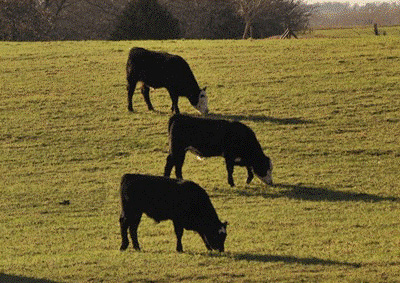
Fall forage yield is an important trait in dual-purpose systems because it sets the potential for beef production from wheat grazing in the fall, winter, and early spring. Approximately 100 pounds of beef per acre can be produced for every 1,000 pounds of wheat forage produced in an acre. Forage production depends on variety, planting date, seeding and nitrogen rates, fall temperature, and precipitation.
The date of the first hollow stem is also an important trait in dual-purpose systems because terminating grazing at the right time is essential to maintaining the grain yield potential for subsequent harvest. Grazing past the first hollow stem can decrease wheat grain yield by as much as 1 to 5% per day.
Depending on environmental conditions, varieties with a shorter vernalization requirement might reach first hollow stem 15 to 20 days earlier than varieties with a longer vernalization requirement. An earlier occurrence of first hollow stem reduces the grazing window into early spring. The date of first hollow stem is dependent on temperature and day length.
Grain yield following grazing is another variety-specific trait important in dual-purpose systems. Varieties that rely mostly on fall-formed tillers to produce grain yield generally show a greater yield penalty due to grazing than varieties with a good spring tiller potential.
Description of site and methods
Sixteen commonly grown winter wheat varieties, as well as pre-release lines, were sown in three neighboring trials in the South Central Experiment Field near Hutchinson, Kansas. Two trials were sown to simulate dual-purpose management, characterized by an early sowing date, increased nitrogen rate, and higher seeding rate, while a third trial was sown using the same varieties under grain-only management. The full publication provides more information on the experiment methods and site characteristics.
Fall forage yield
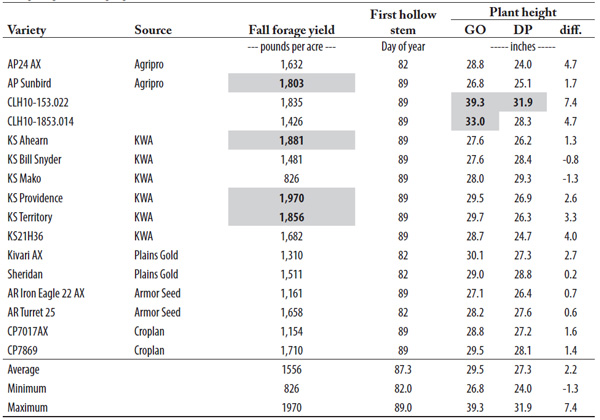
Fall forage production of the varieties evaluated ranged from 826 to 1,970 pounds of dry matter per acre, averaging 1,556 pounds of dry matter per acre (Table 1). There were significant statistical differences among the varieties, with AP Sunbird, KS Ahearn, KS Providence, and KS Territory falling into the highest forage-yielding group (range within the highest-yielding group: 1,803 to 1,970 pounds of dry matter per acre).
First hollow stem
First hollow stem is reported in the day of year format. For reference, day of year 80 is equivalent to March 21. The average occurrence of first hollow stem was day 87 (Table 3), ranging from day of year 82 for early varieties to day of year 89 for late varieties. These dates represent a normal to slightly delayed release from winter dormancy. The range in first hollow stem was narrow, with all studied varieties reaching first hollow stem within a 7-day interval. Four varieties reached it early (AP24 AX, Kivari AX, Sheridan, and AR Turret 25), and all remaining varieties were past this stage at the subsequent measurement.
Previous reports of the first hollow stem from Oklahoma have shown that early varieties may reach first hollow stem as much as 30 days earlier than later varieties, depending on environmental conditions. Kansas results may differ from Oklahoma results due to cooler winter temperatures holding crop development across varieties, and their interaction with photoperiod as day lengths were already long when temperatures were warm enough to allow for crop development.
Plant height
Varieties and cropping systems also differed significantly in plant height (Table 1). Plant height in the grain-only system averaged 29.5 inches, ranging from 26.8 to 39.3 inches. This average was -1.3 to 7.4 inches taller than the heights measured in the dual-purpose system (27.3 inches average height with a range of 24.0 to 31.9 inches).
Table 1. Fall dry matter forage yield, date of first hollow stem, and plant height under grain-only (GO) and dual-purpose (DP) systems in Hutchinson, KS, during the 2024-25 production year. Shaded values refer to the highest testing group. Values pertaining to the highest group are highlighted in bold.
Grain yield and grain test weight in grain-only or dual-purpose systems
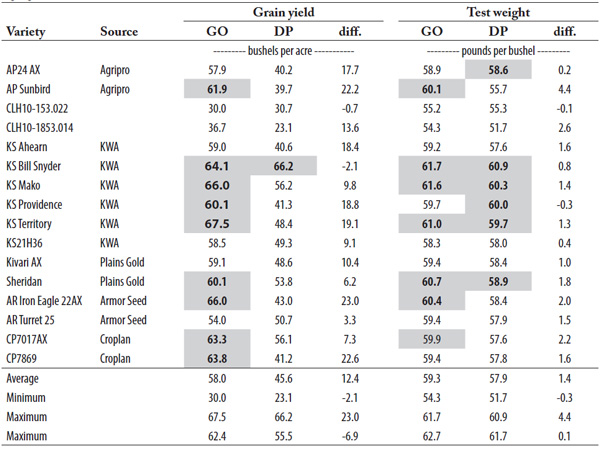
The average grain yield in the grain-only trial was 58.0 bushels per acre, whereas the dual-purpose trial averaged 45.6 bushels per acre (Table 2). Varieties that yielded statistically better than their counterparts in the grain-only trial were AP Sunbird, KS Bill Snyder, KS Mako, KS Providence, KS Territory, Sheridan, AR Iron Eagle 22AX, CP7017AX, and CP7869. The yield penalty from simulated grazing averaged 12.4 bushels per acre and ranged from 2.1 to 23.0 bushels per acre. The variety KS Bill Snyder was the highest-yielding variety of the dual-purpose trial. The weather conditions — characterized by cool and moist grain fill weather — benefited some of the later-maturing wheat varieties this season.
Test weights ranged from 54.3 to 61.7 pounds per bushel in the grain-only system and from 51.7 to 60.9 in the dual-purpose system (Table 2). Varieties with the highest test weight at both grain-only and dual-purpose systems were KS Bill Snyder, KS Mako, KS Territory, and Sheridan, whereas the varieties AP Sunbird, AR Iron Eagle 22AX, and CP7017AX were in the highest test weight group under grain-only, and AP24 AX and KS Providence were in the highest test group in the dual-purpose trial.
Table 2. Winter wheat grain yield and grain test weight in grain-only (GO) and dual-purpose (DP) systems in Hutchinson, KS, during the 2024-25 production year. Shaded values refer to the highest testing group. Values pertaining to the highest group are highlighted in bold.
Romulo Lollato, Extension Wheat and Forage Specialist, lollato@ksu.edu
Jane Lingenfelser, Assistant Agronomist, jling@ksu.edu
 Kansas Forage and Grassland Council
You must be logged in to post a comment.