
Jennifer M. Latzke, Editor, April 15, 2025
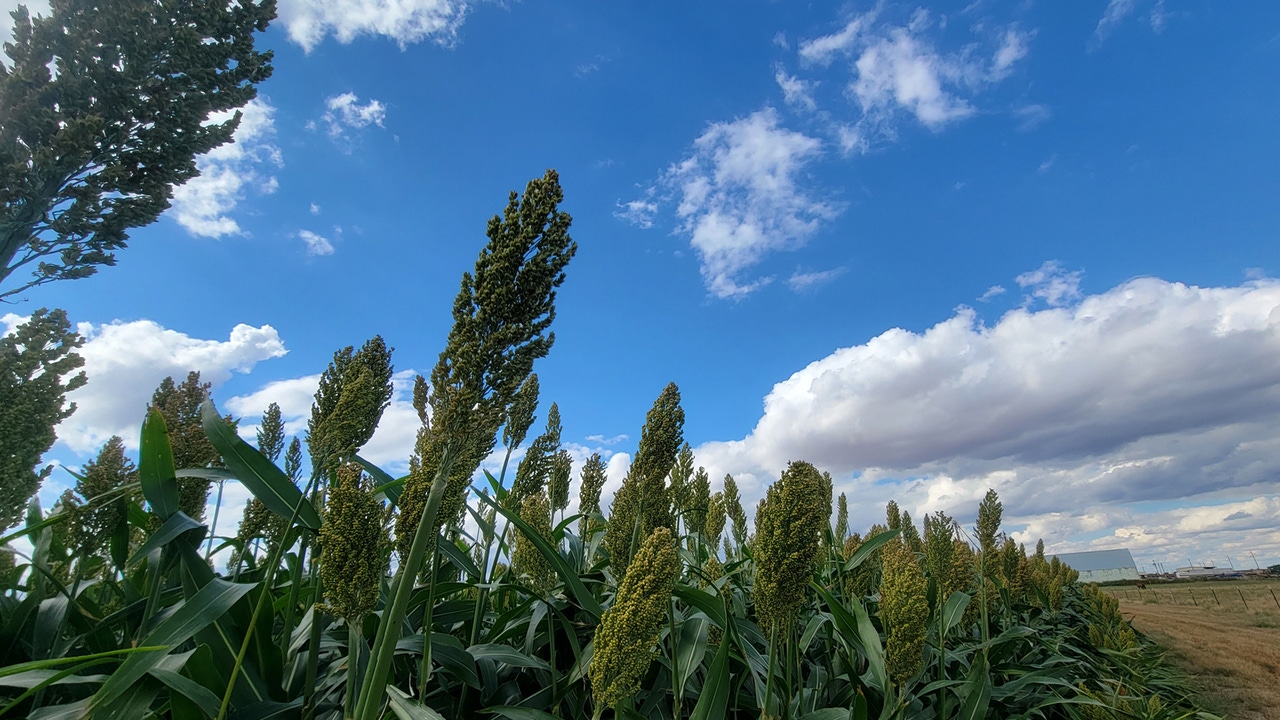
FORAGE HYBRID: S&W Seed Co. rolled out a prussic acid-free sorghum-sudangrass hybrid that could be a game-changer for grazers and farmers concerned about prussic acid poisoning. Shelley E. Huguley
Forage sorghum, sorghum-sudangrass and sudangrass have their role in many cattle production systems. But many farmers shy away from feeding these nutritionally packed forages because they don’t want to risk prussic acid poisoning.
S&W Seed Co., working with experts from Purdue University, says it has an answer — PF Trait, a non-GMO trait that guarantees prussic acid-free sorghum.
Sorghum and sudangrass evolved with a strong protective mechanism against insect feeding, and that is a substance called dhurrin that’s found in the epidermal cells of the plant, explains Mitch Tuinstra, professor of plant breeding and genetics at Purdue. Dhurrin is the precursor to prussic acid, or cyanide, which interferes with the ability of the blood to carry oxygen and results in rapid death.
Younger plants typically have more dhurrin than older plants, and tillers often have more than mature plants. This is why it’s generally safe to graze forage sorghum or sorghum-sudangrass after the plant is mature and 18 to 24 inches tall.
But when the plant is stressed by drought or frost, it can result in an increase in dhurrin content, which is why conventional advice is to remove livestock from grazing after a frost for at least one week.
What if you could stop dhurrin?
Tuinstra had a crazy thought one day. Could there be a forage sorghum that doesn’t produce dhurrin, and therefore doesn’t produce prussic acid and could be a safer grazing alternative?
Tuinstra’s work at Purdue found that by blocking the CYP79A1 enzyme in the genetics of forage sorghum, the plant could not create dhurrin, and therefore it is safe from producing prussic acid. After 20 months of screening more than 50,000 plants, Tuinstra and his team found they could knock out this one enzyme using biosynthesis.
That work led to a collaboration with S&W Seed Co. to roll out the first hybrid forage sorghum-sudangrass with the PF Trait, SP4408 PF, a headed-type non-BMR.
Scott Staggenborg, product marketing manager for the Americas at S&W Seed Co., explains that a prussic acid-free sorghum has a lot of benefits to the farmer and the cattleman, but chiefly brings peace of mind during a very busy time of year for farms. The company extensively field-tested its PF hybrids in freezing and near-freezing conditions and found that there was no prussic acid produced by any growing plant in the field. And that means less labor for farmers.
“Most of our frosts occur in October, at a time when we’re trying to do things like strip cotton, pick corn, plant wheat and all of these operations that are really important,” Staggenborg says. Taking time from field work to test frost-damaged forage or sorghum-sudangrass and moving cattle can be difficult, especially if you don’t have the labor.
Second, a PF Traited sorghum can extend the grazing period for rotational grazers, Staggenborg explains. If a farmer could graze cattle on the PF sorghum until it stops growing or there’s nothing left in the field to graze, that’s saving costly hay. Additionally, by not worrying about small tillers producing prussic acid in these PF Traited sorghums, farmers can put cattle out earlier in the summer. Farmers surveyed estimated that they could get an extra two weeks to a month of added grazing, Staggenborg says.
Happy cows
Ultimately, the real test is whether the cattle will eat it. Staggenborg says that in grazing trials, cattle and sheep both grazed the PF sorghum first before grazing the other conventional sorghums in the plot.
“The animals in the plots went to that PF sorghum first and grazed it to the ground — leaves, whorl, stalks and all,” Staggenborg says. “And then they switched to the conventional hybrids.”
Wildlife also finds it highly palatable, he says.
Staggenborg and Tuinstra caution that even though the PF Trait removes prussic acid, the plant still can produce nitrates, so farmers should watch livestock in situations where nitrate poisoning could be a concern. Additionally, wild sorghum relatives still produce prussic acid, so farmers adopting this trait in their fields must work to control wild grasses where cattle graze.
Related:Hay production rose in 2025
Staggenborg says there is work in the pipeline to produce a BMR version of SP4409 PF, as well as a Double Team + PF-stacked hybrid grain sorghum.
Why forage sorghum?
For some farmers, there are several livestock and soil health benefits from growing forage sorghums.
Chiefly, forage sorghum hybrids produce a lot of biomass using little water and fertilizer, which is ideal for farmers in low-water situations. The organic matter from forage sorghums also can boost soil structure, while their root systems can break up compaction in soil.
Forage sorghum is a versatile feedstock, and can be fed as hay, silage and green chop or used for pasture. Forage sorghum fed as a silage has a 10% to 20% lower energy value than corn silage, but it can have higher protein and higher fiber content, according to the University of Nebraska.
Many farmers today use forage sorghum or sorghum-sudangrass in their rotational grazing programs for its soil health properties and to extend their grazing season.
 Kansas Forage and Grassland Council
You must be logged in to post a comment.