

Planting cereal rye after corn harvest
A publication from K-State and the Midwest Cover Crop Council provides helpful information for producers looking to incorporate a cereal rye cover crop following corn harvest. This factsheet is an excellent resource for farmers that are new to cover crops.
Cereal rye can be part of an effective weed management program in soybean production. The growing cover crop competes with weeds that emerge early in the spring, and residue from the terminated cereal rye can suppress weed growth. Cereal rye residue can also reduce evaporation from the soil during the growing season (Figure 1).
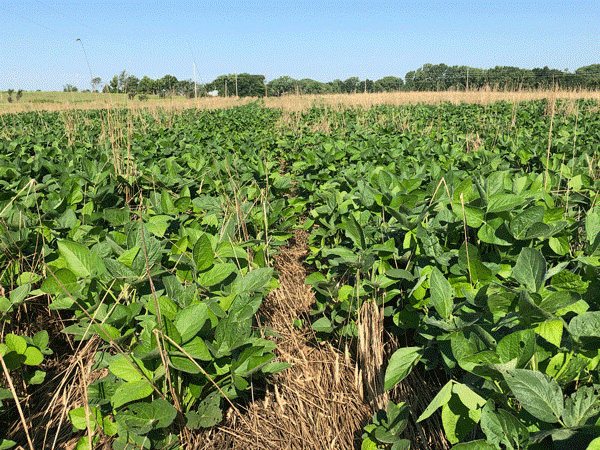
Figure 1. “Clean” soybeans – the heavy residue mat from the terminated cereal rye cover crop is helping control weeds throughout the growing season. Photo by DeAnn Presley, K-State Research and Extension.
Planning and Preparation
- Residual corn herbicides—Fall-seeded cereal rye can be established successfully following the application of most herbicides used in corn production, but success is influenced by herbicide rate and environmental conditions that follow the herbicide application. If cereal rye will be grazed or fed to livestock, there are some restrictions. See the USDA-NRCS Cover Crop Termination Guidelines, or consult your agricultural chemical supplier or agronomist for potential carryover herbicide concerns, and always read and follow the instructions on the herbicide label.
- Seed purchase—Order cereal rye seed early. Named varieties can produce substantially more growth or more predictable growth and maturity but are more expensive than VNS (variety not stated) seed. Start with VNS seed with a good germination rate that is purchased from a reputable seed dealer. This means the seed has been cleaned, tested for germination, and has a seed tag even though it is VNS.
Fall Work
- Corn harvest—Harvest the crop as early as possible in fields to be planted to cereal rye.
- Tillage or no-tillage—To allow for adequate cover crop growth, it is best or easier if no full-width tillage is planned for after rye planting or before the intended rye termination date. Thus, it is easier to integrate cover crops into no-till or strip-till systems.
- Timing of planting—Plant cereal rye as soon after corn harvest as possible. Use the Cover Crop Selector Tool (in Resources) to find planting dates for your county. For most of Kansas, plant no later than November 1.
- Seeding rate—The recommended drilled seeding rate is 55 to 60 pounds per acre; if seeded with an airplane, the rates should be 1.5 times the drilled rate (required if participating in USDA-NRCS programs). These rates are based on high-quality seed with germination rates of 85 to 98%. Increase rates with later plantings.
- Planting method—Drill seed 0.75 to 1.50 inches deep or broadcast with shallow incorporation.
This publication covers various topics, which are summarized in this article. The complete factsheet can be viewed at: https://bookstore.ksre.ksu.edu/pubs/MF3504.pdf.
Additional resources
Cover Crop Selector Tool – http://mccc.msu.edu/selector-tool/, available from Midwest Cover Crops Council, www.mccc.msu.edu
USDA-NRCS Cover Crop Termination Guidelines – https://www.rma.usda.gov/en/Topics/Cover-Crops
DeAnn Presley, Soil Management Specialist
deann@ksu.edu
Sarah Lancaster, Extension Weed Science Specialist,
slancaster@ksu.edu
Fall soil testing of hayfields and pastures
Knowing the soil nutrients is a requirement for establishing an adequate soil fertility program for forages. Soil testing can be done in either spring or fall on hayfields and pastures. Given a choice, fall would be the preferred time because it allows more time for any needed lime applications to have an effect before the main growing season begins and gives the producer some flexibility for planning nutrient applications.
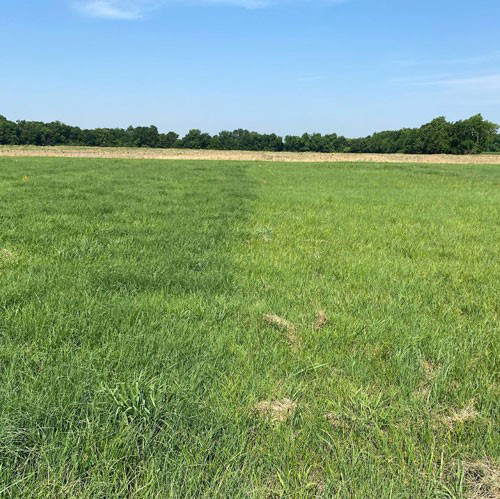
Figure 1. Fertility management effect in bermudagrass pastures. The left side of the pasture received an application of nitrogen fertilizer, while the right side did not. Photo credit: K-State Research and Extension.
Soil sampling is typically recommended at least every 3-4 years, but more frequent sampling (every two years) can prevent excessive and unnecessary application of fertilizer or manure and increase yields by revealing exactly which soil nutrients are too low for optimum productivity. This is particularly important during years with high fertilizer prices.
Tips for collecting a representative soil sample
To take accurate soil samples, it is best to use a soil probe. You can borrow a probe from many county Extension or NRCS offices. A shovel or spade can also be used, but make sure to dig a hole first and then take a nice, even slice to the correct depth. A shovel or spade that angles to a point at the bottom can easily result in misleading soil test results because the sample is biased by having more soil from the surface and less from lower depths.
When taking soil samples, it is important to have a representative composite soil sample from the field by combining several soil cores (in a clean container, avoiding contamination) and mixing thoroughly. Ideally, one composite soil sample should represent a uniform and treatable area, not exceeding 40 acres, and no more than 10 acres for more variable fields. In these areas, take 15 to 20 cores or subsamples to make up your representative composite sample. If the field has areas where different forages or crops have been grown or have different soil types, then soil sampling from these areas should be done separately.
For pH evaluation, the sampling depth for pastures and hayfields should be 3 to 4 inches. A 24-inch sample is needed for mobile nutrients, nitrogen, and sulfur. A 6-inch depth is preferred for phosphorus and potassium when submitting samples to the K-State Soil Testing Laboratory since that is the depth we have used to calibrate recommendations.
Soil pH is important
Soil pH is one key soil property for forage production, especially with legumes. The optimal pH level is 6 to 7, depending on the forage species. Grasses such as brome or fescue do well at lower pH than legumes, especially alfalfa, which requires a near-neutral pH (~pH 7). Nutrient uptake can be reduced if the soil pH is too low or too high. The impact of pH on nodulation and nitrogen fixation is especially important for legumes such as alfalfa and clover. At low soil pH, aluminum toxicity can also be an issue.
When you lime a new pasture, it is important to apply the lime 6 to 12 months before planting. If you want to get a more rapid response from liming, use fine-ground liming materials with a high effective calcium carbonate (ECC). Fields that will be planted to alfalfa next spring should also be evaluated for phosphorus and potassium levels and corrections should be made before planting. Sulfur and boron may also be a limiting nutrient for legumes, especially in eastern Kansas.
For more information on soil sampling and submitting samples to the K-State Soil Testing Laboratory, visit their website at http://www.agronomy.k-state.edu/services/soiltesting/. You can also access two previous eUpdate articles discussing fall soil sampling and collecting a representative soil sample in Issue 974, September 14, 2023.
Dorivar Ruiz Diaz, Nutrient Management Specialist
ruizdiaz@ksu.edu
Tina Sullivan, Northeast Area Agronomist
tsullivan@ksu.edu
 Kansas Forage and Grassland Council
You must be logged in to post a comment.