

Grasshoppers are abundant in many areas of Kansas
It is well understood that weather patterns can have a significant impact on grasshopper populations year to year. Warm, dry weather increases the survival of nymphs and adult grasshoppers, leading to increased egg production during the growing season, while cool, wet weather promotes fungal pathogens that can reduce egg and nymph survival. The abundance of grasshoppers being observed now is likely due to the weather patterns of the last couple seasons. Another factor influencing grasshopper populations is an abundance of food, especially broadleaf weeds. A diet high in these forbs leads to greater nymph survival, faster growth, larger adult grasshoppers, and increased egg production. Despite many areas still being impacted by some level of drought, sporadic rainfall over the growing season has helped weeds persist in many areas of the state, which has likely contributed to the noticeable number and diversity of grasshoppers currently being observed. As these weedy sources of food are exhausted or controlled, grasshoppers may shift their grazing over to anything still growing in the landscape. In areas with greater grasshopper pressure, seedling alfalfa and wheat could be at risk.
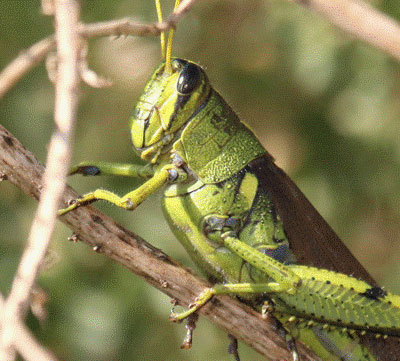
Figure 1. Adult grasshopper. Photo by Anthony Zukoff, K-State Research and Extension.
Before planting alfalfa, treatment should be considered if there are 15 or more grasshoppers per square yard around the planting area. Once planted and growing, consider treatment if 3-5 grasshoppers per square yard are found in the seedling alfalfa stand.
Vegetated borders around areas where wheat will be planted should be scouted ten days before planting. Consider treating those borders if there are 7 to 12 grasshoppers per square yard. Once growing, three or more grasshoppers per square yard within the field can destroy seedling wheat stands. If grasshopper populations are low to moderate, seed treatments can protect emerging wheat plants for several weeks if products are applied at the highest registered rate. Seed treatments will be less effective under severe grasshopper pressure as the insects can consume a large amount of leaf material before succumbing to the seed treatments. It is advisable to avoid planting too early, as this will help reduce the time that wheat must be protected.
Please refer to the most recent Alfalfa and Wheat Insect Management Guides for specific control information. Alfalfa Insect Management Guide https://bookstore.ksre.ksu.edu/pubs/MF809.pdf, Wheat Insect Management Guide https://bookstore.ksre.ksu.edu/pubs/MF745.pdf, Anthony Zukoff, Extension Entomology Associate – Garden City, azukoff@ksu.edu
Update on fall armyworms and armyworms
There is much concern relative to “worms” feeding on brome and the prospect of those worms moving to wheat when it germinates. Infestations currently consist of either fall armyworms or armyworms. At this point, both seem to be mature larvae; thus, feeding damage is about finished for at least a couple of weeks. Fall armyworms do not usually overwinter in Kansas. Thus, after these larvae (worms) pupate in the soil and emerge as adult moths, hopefully, they will not oviposit in Kansas but head south for overwintering. Armyworms, however, can overwinter in Kansas. After they pupate in the soil, they may mate and search for actively growing plants to deposit their eggs. In agriculture, this is often brome or wheat. Late-planted wheat, however, often avoids this armyworm infestation. Plus, if there is no volunteer wheat available for these moths, that also helps tremendously to mitigate damage.
KSRE Crop Production Extension Agent Jay Wisbey provided a good example of a brome field affected by armyworm/fall armyworm feeding, plus some grasshoppers, coupled with dry conditions. The photo was taken near Gypsum in Saline County (Figure 1).
For more information about fall armyworms and/or armyworm management, please refer to the KSRE Wheat Insect Management Guide 2024 at https://bookstore.ksre.ksu.edu/item/wheat-insect-pest-management-2024_MF745. For recent insecticide efficacy results, see Table 1 below.
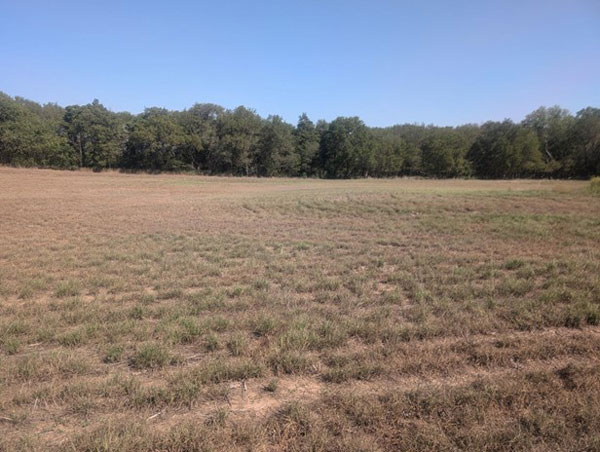
Figure 1. Damaged brome field near Gypsum, KS, on September 10, 2024. Photo by Jay Wisbey, K-State Research and Extension.
Table 1. Efficacy trials to control armyworms in brome. DAT=days after treatment.
| Total worms/sq. ft (averaged over four replications) | |||
| Treatment | Rate | 9/19/2021 (7 DAT) | 9/26/2021 (14 DAT) |
| Fastac CS | 2.4 fl. oz/a | 0 | 1 |
| Besiege XL | 8.0 fl. oz/a | 0 | 2 |
| Stallion | 6.0 fl. oz/a | 0 | 2 |
| Grizzly Z | 2.5 fl. oz/a | 0 | 0 |
| Lorsban 4E | 1.5 pint/a | 3 | 3 |
| Check (control) | – | 25 | 26 |
| Check (control) | – | 18 | 20 |
Jeff Whitworth, Extension Entomologist
jwhitwor@ksu.edu
 Kansas Forage and Grassland Council
You must be logged in to post a comment.