

Fall forage yield is an important aspect of dual-purpose wheat production. In this system, wheat is typically sown earlier than grain-only production, at higher seeding rates, and with additional nitrogen fertilizer to maximize forage production.
The weather experienced during the fall is crucial to determine the average level of forage yield, with warm and moist weather typically resulting in greater forage yield than cool and dry weather conditions. Management practices that also maximize forage yield are early sowing, higher seeding rates, placement of in-furrow phosphorus fertilizer with the seed at sowing, and fall nitrogen fertilization.
While the weather is typically the largest player in determining fall forage production, followed by management, there are also differences among wheat varieties in forage production potential. Thus, the K-State Wheat Production Group compares the forage yield of several commonly grown wheat varieties and upcoming lines every year. This test is usually performed in the South Central Experimental Field near Hutchinson, Kansas (Fig. 1), and the forage sampling occurs sometime during December (Table 1).
At the sampling conducted on November 30, 2023, there were significant differences among varieties regarding forage accumulation. The average forage yield was 1,353 lbs dry matter (DM) per acre with a range from 871 to 1,969 lbs DM/a. The varieties that exhibited the highest forage yield were AP24AX, AP Prolific, AR Iron Eagle 22AX, CP7017AX, CP7266AX, CP7909, Croplan CP15CW3388#011, Guardian, KS Ahearn, KS Providence, and Limagrain LCH16AC403-158 (Table 1). The remaining varieties produced statistically less forage than these.
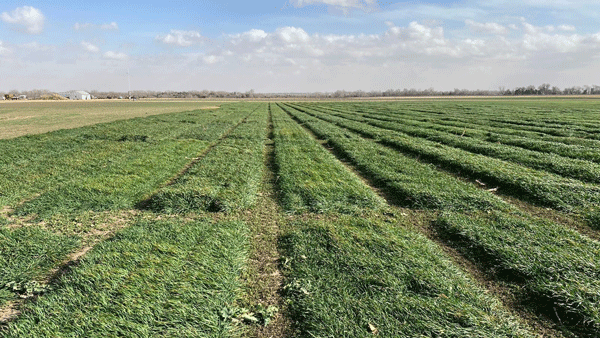
Figure 1. Dual-purpose wheat trial near Hutchinson, KS. Photo by Romulo Lollato, K-State Research and Extension.
Table 1. Fall forage yield of wheat varieties sown under dual-purpose system near Hutchinson, KS. Forage biomass was collected on November 30, 2023. Data is shown in pounds of dry matter per acre (lbs DM/ac). There were significant statistical differences among varieties at the 5% probability level. Varieties are listed in alphabetical order, and the bold highlight indicates the highest forage-yielding group.
| Variety | Forage DM yield (lbs/a) |
| AP24 AX | 1492 |
| AP Prolific | 1678 |
| AR Iron Eagle 22AX | 1473 |
| CP 7017AX | 1606 |
| CP 7266AX | 1649 |
| CP 7869 | 871 |
| CP 7909 | 1665 |
| Croplan CP15CW3388#011 | 1370 |
| Guardian | 1510 |
| KS Ahearn | 1740 |
| KS Providence | 1958 |
| Kivari AX | 1082 |
| Limagrain LCH16AC403-158 | 1969 |
| Polansky XP24-11 | 875 |
| Roadrunner | 1246 |
| WB4347 | 1154 |
| Average | 1459 |
| Minimum | 871 |
| Maximum | 1969 |
Another important aspect of dual-purpose wheat production is how long each variety can be grazed in the spring. This is measured as the date for the first hollow stem, and varieties can differ in as much as 20-30 days in achieving the first hollow stem in the spring. The Wheat Production Group at K-State uses this very same trial to measure first hollow stem development during late February and early March. The eUpdate will publish updates on the progress of first hollow stem development until all tested varieties have reached this stage.
Romulo Lollato, Extension Wheat and Forages Specialist
lollato@ksu.edu
Mariana Mota, Visiting Scholar
Luiz Otavio Pradella, MS student
Maximo Nores Allende, Visiting Scholar
 Kansas Forage and Grassland Council
You must be logged in to post a comment.